
Canada’s Clean Hydrogen Investment Tax Credit (ITC) is one of the most attractive incentives for companies investing in low-carbon hydrogen projects. It can cover up to 40% of eligible capital costs, but maximizing the benefit requires more than understanding carbon intensity tiers, it requires aligning engineering design, documentation, and labour compliance from day one.
While much of the focus is on carbon intensity and technology pathways, developers are increasingly finding that labour compliance and documentation are critical to actually securing the full value of the credit.
1. What Is the Clean Hydrogen ITC?
The Clean Hydrogen ITC is a refundable federal tax credit for Canadian projects that produce low-carbon hydrogen:
- Eligible for property acquired between March 28, 2023, and December 31, 2034
- Reduces project costs while promoting clean energy and workforce development
- Administered by CRA, with technical validation from Natural Resources Canada
2. Carbon Intensity Tiers: How Your Credit Is Calculated
Hydrogen must have a carbon intensity (CI) of less than 4 kg CO₂e/kg H₂, measured over its lifecycle. The lower the CI, the higher the ITC rate:
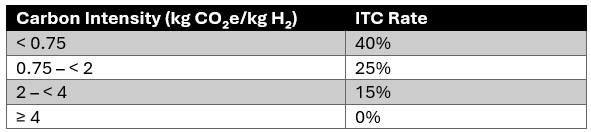
Note: Assets placed in service in 2034 receive half the applicable ITC rate.
Early-stage assumptions in CI modelling can materially impact final ITC eligibility if not aligned with actual operating conditions.
3. Eligible Equipment
The ITC applies to equipment directly used in hydrogen produced from an eligible pathway, including:
- Electrolyzers and reformers
- Hydrogen compression, storage, and purification systems
- Supporting systems: water treatment, cooling, and electrical systems
Determining whether supporting electrical systems or dedicated power infrastructure qualify can depend on how closely they are integrated with hydrogen production.
Not eligible: buildings, vehicles, or distribution infrastructure.
4. Submitting Your Project Plan to NRCan
To claim the ITC, you must submit a project plan to NRCan, including:
- Project description: technology, location, production process
- Engineering design & drawings: FEED study, block flow diagrams, PFDs, P&IDs
- Carbon intensity modelling: lifecycle analysis (LCA) calculations
- Validation report: third-party confirmation of projected CI
The plan establishes a baseline for a 5-year compliance period, and actual performance will be measured against it. The project plan effectively locks in your assumptions, and deviations during operations can impact ITC eligibility.
5. Labour Requirements: Prevailing Wage & Apprenticeship
Labour requirements are one of the most commonly underestimated risks in Clean Hydrogen ITC claims and one of the easiest ways to lose a portion of the credit if not managed properly.
To claim the full ITC rate, you must elect to meet labour requirements, which include:
Prevailing Wage Requirement
- Workers on eligible construction activities must be paid prevailing wages, including benefits
- Applies to all contractors and subcontractors performing eligible labour on site
Apprenticeship Requirement
- At least 10% of labour hours worked by Red Seal workers must be worked by registered apprentices
- Apprentices must provide evidence of registration in a Red Seal or provincial program
- Probationary or unregistered workers are not eligible
Meeting the threshold is not just about hiring apprentices and paying specific wages. It requires accurate tracking of eligible labour hours, proper documentation, and robust data management practices.
6. Claiming One or More Clean Economy ITCs
A project may qualify for multiple Clean Economy ITCs, but careful tracking is essential:
- No double-counting of the same property (e.g., electrolyzers can’t be claimed under two ITCs)
- Separate property pools for different ITCs
- Document everything to avoid audit issues or clawbacks
Improper allocation between ITCs is a common audit risk.
7. Labour compliance is often where Clean Hydrogen ITC value is won or lost.
From prevailing wage requirements to apprenticeship tracking and audit-ready documentation, developers need systems in place early to avoid risk and ensure full credit eligibility.
At Compass Energy Consulting, we work with project teams to design and implement labour compliance strategies that align with real construction execution, not just policy requirements.
If you’re working on a hydrogen or clean energy project, feel free to reach out. We’re always happy to share insights and support your team.